Powerful market insights, backed by Tradebyte data

E-COMMERCE IN 2026: WHAT’S SHAPING THE MARKEt

The way consumers discover and buy products is changing faster than ever before, with Agentic AI emerging as a key driver of e-commerce. Ongoing trade disruptions, the rise of developing regions and new shopping hotspots are shaping the landscape for 2026. But what strategies are arising from them?

Our annual forecasting report is back! We’ve gathered the key trends and actionable insights you should know about to lead the market in the coming year.
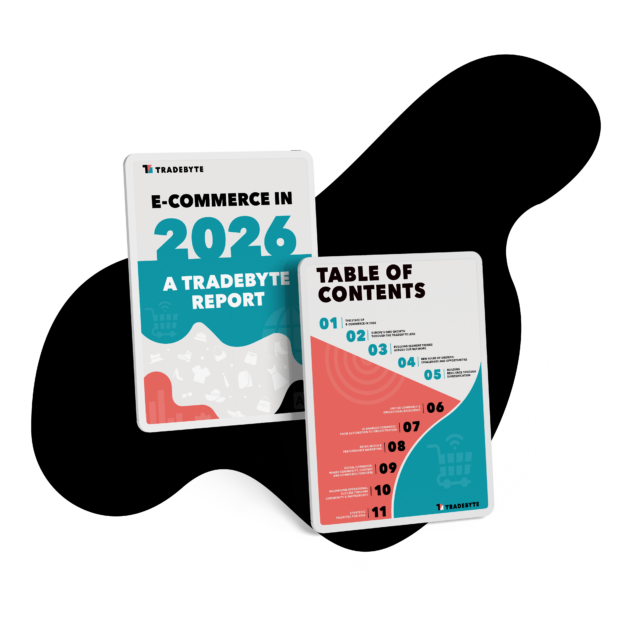

Download the report

CONSUMERS REWRITING THE RULES

47% of shoppers now start their journey on marketplaces. Only 24% still head to search engines first. (Sapio Research, 2025).

TikTok is officially overtaking traditional search for younger audiences, with ~43% of Gen Z starting their product searches in the app.

AI drove $67 billion in sales during Cyberweek 2025, influencing 20% of all purchases (Salesforce, 2025).

set the pace for success 

E-COMMERCe trends in 2026

  • A RESHAPED GLOBAL E-COMMERCE LANDSCAPE

    Global retail e-commerce is expected to reach $7 trillion in 2026, driven by steady growth as digital adoption stabilises in mature markets and climbs in developing ones (eMarketer, 2025). While China, the US, and Western Europe still dominate 80% of global sales, new growth engines are shifting the map. All eyes are on Central and Eastern Europe (CEE), the Nordics, the Middle East, India and Turkey. With tariff increases and trade disruptions as top risks, the focus is shifting toward nearshoring, reshoring, and the need for diversification.

  • RESILIENCE THROUGH DIVERSIFICATION & UNIFIED COMMERCE

    Diversification has moved from a strategic advantage to a structural necessity. In a year shaped by tariffs, new regulation, and rising acquisition costs, overexposure to a single region, platform, or channel is a real risk. Although diversifying sales channels can mitigate risk and maximise customer reach, unified commerce is the key to achieving sustainable growth. It connects every front-end experience to a single operational backbone, creating a shared view of stock, orders, prices, and returns across all sales channels. Success in 2026 will highly depend on treating e-commerce not as a single channel, but as a unified ecosystem.

  • PRODUCT DISCOVERY REIMAGINED

    The way shoppers find products is becoming increasingly fragmented. New interfaces and patterns, such as curated feeds and AI-driven assistants (Agentic Commerce), are changing how products are displayed and compared. With many journeys now starting inside marketplaces, on social feeds, or through AI interfaces rather than traditional search, the focus is shifting toward social commerce, retail media, and AI-optimised content. AI is doing more than just shaping the customer experience; fashion executives now view it as the top strategic priority for succeeding in a fast-paced market.

Felix Hoffmann

CEO of 7Learnings

Consumers rely on more AI support to make their decisions. Retailers and brands need to do the same to stay successful. Pricing is the AI application with the best impact to effort ratio according to Gartner and therefore a great place to start.

Is your strategy set for success?

Build your 2026 roadmap with our data-backed e-commerce forecasting report.

Download the report

GET ACCESS TO THE E-COMMERCE 2026 BREAKDOWN

  • Get a clear view of the market shifts and the strategic priorities you need to lead in 2026.
  • Explore how consumers are redefining product discovery, making social commerce, retail media and AI increasingly important in 2026.
  • Find out how to build resilience with unified commerce and diversification across channels and markets