E-commerce Trends in 2026: Navigating the Redistribution of Growth
Building on our E-Commerce in 2026 Report, we dive into the redistribution of growth and the shift from traditional search to AI-driven discovery. Learn why operational agility and channel diversification are now the primary strategies for business resilience.
In 2026, we’re moving away from the predictable growth of the past toward a more dynamic era of rebalancing. This shift, which forms the central pillar of our E-Commerce in 2026 Report, reveals a fundamental redistribution of demand across new geographic regions, categories, and channels. The core of this evolution is a transformation of the discovery journey: consumers aren’t just spending differently; they are finding products in entirely new ways. Growth is increasingly driven by AI interfaces and social commerce platforms that curate decisions for the shopper before they even hit a search bar. Brands that assume demand will return to old, search-heavy patterns are finding the ground has shifted beneath them.
Key takeaways
- Growth is rebalancing: expansion is no longer about scale, but about capturing demand in a fragmented market through multi-channel diversification.
- The Discovery Revolution: 43% of Gen Z now start their product journey on TikTok. As AI-driven interfaces and social media increasingly take over, consumers are moving away from traditional search patterns.
- Agility as a resilience strategy: operational fluidity and AI-driven decision-making are the #1 competitive advantages to navigate market volatility.
Adaptation as a resilience strategy
The recent situation at Claire’s is a perfect example of what this redistribution looks like in practice. Once a staple of traditional physical retail, the brand faced administration in August last year and again in January 2026 (Drapers, 2026). While Claire’s had huge brand recognition and plenty of emotional history on its side, nostalgia alone was not a strong enough proposition to stay competitive.
Heritage still matters, but only when a business can adapt as fast as the market. Even for an established brand, a famous name will not compensate for slow decisions or rigid operations. The challenge is how quickly customer expectations change around product range, pricing, content, fulfilment, and availability. In 2026, brands need a proposition that feels relevant and the operational capability to deliver it consistently across multiple channels.
Why growth follows agility
The success of value-led models, often seen in the flourishing off-price sector, is a signal for the entire market. It isn’t just about lower prices; it’s about a business model structurally built for volatility and rapid inventory turnover. Driven by value-seeking consumers and supply-chain shifts, off-price is winning because its business model is structurally built for volatility. It relies on rapid inventory turnover and opportunistic sourcing to create a discovery experience that keeps customers coming back.
This model is particularly successful now that consumers are becoming more cost-conscious and selective. Brand loyalty is harder to retain, and market relevance is increasingly dictated by what people see on their daily feeds and across various marketplaces.

Digital retail and its new rules
In 2026, the retail mainstream has evolved into a fast-moving ecosystem where marketplaces, social platforms, and value-led models are the primary places for consumer attention. This new environment is far less forgiving of traditional rigidity. Success is no longer guaranteed by brand heritage alone; instead, it is negotiated through algorithms that prioritise speed, contextual content, and real-time availability. In this space, brands must operate with a new level of fluidity.
The most successful businesses are those built for agility, capable of activating new channels or refreshing assortments without being slowed down by internal bottlenecks or losing control of their inventory. This is no longer just an advantage; it is a requirement for survival in a market that rewards immediate relevance over legacy positioning.
Expanding into multiple channels – encompassing owned sites, marketplaces, and social commerce – is a critical strategy for absorbing shocks from sudden algorithm shifts or rising acquisition costs. This diversified approach ensures brands remain visible across the fragmented search behaviours now shaping discovery, particularly on platforms like TikTok, where 43% of Gen Z now initiate their product searches.
“In 2026, success depends less on scale and more on the ability to operate amid complexity.”
Where established full-price models feel the pressure
This is where established full-price models often feel the strain first. When a business is built on higher margins and slower cycles, the traditional levers like long lead times, rigid sourcing, and fixed cost bases can quickly become liabilities during unexpected market shifts. It is certainly still possible to win as a full-price brand, but the requirements have changed. Success now depends on faster decision-making, tighter prioritisation, and much more flexibility in both distribution and operations.
Tariffs as an accelerant, not just an obstacle
In today’s tariff-heavy economy, full-price retailers are facing rising import costs and significant margin pressure. Off-price players, however, often have a built-in advantage as they frequently source inventory that has already cleared customs, which helps insulate them from direct tariff exposure. The recent performance of TK Maxx (TJX) underlines this, with strong earnings and ambitious expansion plans despite the wider economic uncertainty. It proves that value, flexibility, and speed are the most resilient traits when traditional models are under strain.

What this means for brands today
Not every brand needs to become an off-price retailer, but they do need to learn from that level of efficiency. In practice, this means building agility into the specific parts of the business that dictate speed, relevance and execution across channels. In 2026, success will depend less on scale alone and more on how well brands can operate amid complexity. Diversification, operational adaptability and data-led decision-making are becoming the biggest differentiators, and growth will be defined by a brand’s ability to balance reach with relevance, efficiency with resilience, and expansion with profitability.
Why diversification matters in 2026
Across the Tradebyte network, we see a consistent pattern where growth follows agility. Value is no longer just about price; it is increasingly defined by relevance and timing. Looking back at Claire’s, the challenge wasn’t simply competition, but an operating model that couldn’t adjust quickly enough to where demand was shifting. And today, demand no longer behaves as a single, stable stream. It redistributes quickly across regions, platforms and digital touchpoints. This makes diversification across channels and marketplaces not just a growth strategy, but a resilience strategy. It helps brands maintain visibility as discovery splits across search, social platforms and AI-driven interfaces, while reducing exposure to algorithm shifts and rising acquisition costs.
“Diversification, operational adaptability and data-led decision-making are becoming the biggest differentiators in 2026.”
Agility through unified commerce
The retail market now rewards brands that move with demand rather than those that wait for old patterns to return. Past success offers no immunity in a market defined by redistribution. What matters is whether systems and processes can respond fast enough, which itself depends on strong operational foundations: consistent product data, reliable fulfilment, unified inventory, and flexible platform integrations. When pricing, content, stock and fulfilment are aligned across channels using real-time data, agility becomes an achievable goal.
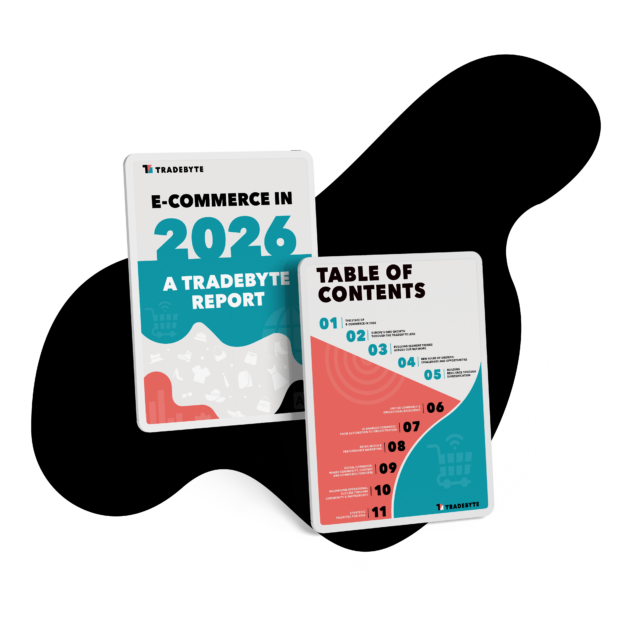
As our E-Commerce in 2026 Report shows, growth is very much possible, but it is moving downstream towards businesses that can adapt quickly and operate efficiently. In a market that is rebalancing this quickly, standing still is the most expensive move a brand can make. The question is no longer if you should adapt, but how fast you can hit the ‘accelerate’ button.
Read more insights on how e-commerce growth is redistributing across markets, categories and channels in Tradebyte’s E-Commerce in 2026 report.
news